
Transfer 2 bytes per single clock pulse through optical fibre
The transceiver consists of multiple monochromatic lasers, each with variable light intensity controlled by input voltage. Each intensity level corresponds to a hexadecimal number (4 bits). Four lasers of different wavelengths, each with 16 intensity levels, together provide 16⁴ = 65,536 combinations, sufficient to transmit a 16-bit binary number per clock pulse.
Invention (What is New)
Variable intensity laser: Each laser emits light at 16 discrete levels. Level 1 corresponds to off; Level 16 to maximum intensity, with 14 intermediate levels evenly spaced. Each level maps to a hexadecimal digit (0 F). Combining four lasers of different colors (e.g., Red, Yellow, Green, Blue) allows simultaneous transfer of a 16-bit number.
Diagram & Description
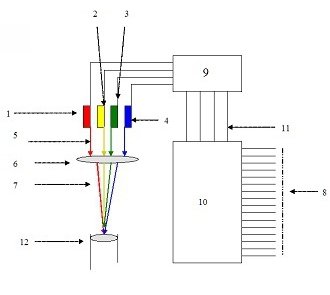
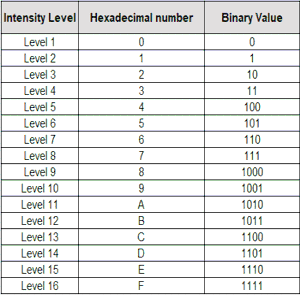
A 16-bit input number is converted to hexadecimal digits. Each digit controls the voltage of one laser. The beams are collimated into a single optical fibre. At the receiver, a prism separates wavelengths. Sensors detect light intensities, producing voltages mapped back to hexadecimal digits, then converted to the original 16-bit binary number. Thus, two bytes are transmitted per clock pulse.
Construction & Working
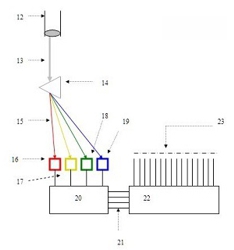
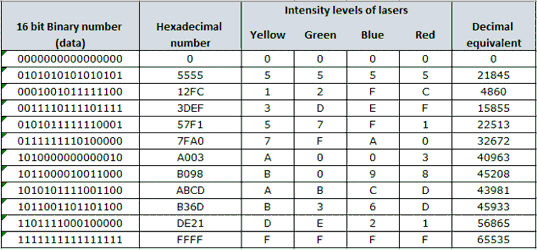
The receiver prism splits incoming light into four wavelengths. Separate sensors detect intensities, generating proportional voltages. These are decoded into hexadecimal digits and reassembled into a 16-bit binary number. The method allows transmission of 2 bytes per clock pulse versus traditional 1 bit per pulse, dramatically increasing data rate with multiplexing.